Understanding the strengths and limitations of different fuel types is essential for households and industries seeking efficient and sustainable energy solutions. Before exploring this comparison in detail, readers may find it helpful to review the article advantages and disadvantages of briquettes as an alternative fuel. The article explains the basic characteristics and uses of briquettes in modern energy systems. Additional insights into alternative fuels, biomass energy, and sustainability topics are available on jacoid.com, a platform that regularly shares updates from the alternative fuel industry.
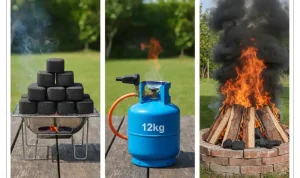
As energy demand continues to grow, charcoal briquettes, LPG gas, and firewood remain widely used in many regions.. Each fuel has different strengths and limitations related to efficiency, cost, environmental impact, and practicality. This article compares charcoal briquettes with LPG gas and firewood to help readers understand their key differences.
Fuel Characteristics and Availability

Charcoal briquettes come from carbonized biomass such as coconut shells, sawdust, and agricultural waste. Their uniform shape makes storage and use easier. Firewood comes from natural wood and varies in moisture, size, and burning behavior. LPG gas is a fossil fuel supplied in pressurized cylinders, offering consistent energy through industrial processing and distribution.
In terms of availability, firewood and briquettes are often more accessible in rural or biomass-rich areas, while LPG gas is more common in urban settings with established supply infrastructure.
Energy Efficiency and Performance
When comparing energy performance, LPG gas generally provides the highest efficiency. It ignites quickly, produces steady heat, and allows precise temperature control. This makes LPG popular for household cooking and commercial kitchens.
Charcoal briquettes provide stable heat and longer burning times than firewood. Although they ignite more slowly than LPG, they deliver consistent heat for cooking, grilling, and small-scale industrial use. Firewood burns less efficiently due to higher moisture and uneven combustion, which reduces heat output.
Environmental Impact

Environmental factors strongly influence fuel choice. Biomass-based charcoal briquettes are often considered low-carbon fuels. They reduce waste, help limit deforestation, and generally produce less smoke than traditional firewood when used with proper stoves.
Firewood can contribute to deforestation if sourced unsustainably and produces higher smoke and particulate emissions. LPG gas burns cleanly with minimal smoke, but as a fossil fuel, it still contributes to greenhouse gas emissions and relies on non-renewable resources.
Cost and Economic Factors
Cost efficiency varies by region. Firewood may appear inexpensive, especially when locally sourced, but its lower efficiency often leads to higher long-term consumption. LPG gas prices can fluctuate due to global energy markets, making it less predictable for some users.
Charcoal briquettes often provide a balanced option. In many areas, they are competitively priced, offer longer burn times, and reduce fuel waste. Local production of briquettes can also support regional economies and reduce transportation costs.
Practical Use and Safety
LPG gas offers convenience and cleanliness but requires proper handling and safety measures due to the risk of leaks or explosions. Firewood and briquettes are generally safer in terms of storage, though proper ventilation is still necessary during use.
Charcoal briquettes stand out as a practical middle-ground fuel, offering better efficiency and environmental performance than firewood while remaining more accessible and affordable than LPG in certain regions.
Conclusion
The comparison of charcoal briquettes with LPG gas and firewood highlights that no single fuel is perfect for all situations. LPG gas offers high efficiency and convenience, while firewood remains widely available but poses environmental challenges. Charcoal briquettes provide a balanced alternative by combining reasonable cost, cleaner combustion, and environmental benefits. As a result, they serve as a practical energy solution for households and industries seeking more sustainable fuel options.