The coconut shell carbonization process transforms organic waste into economically valuable and environmentally friendly products. This technology represents a crucial stage in producing high-quality charcoal. Coconut shell carbonization process involves technical stages that require precise control for optimal results.
With increasing global demand for sustainable charcoal, understanding carbonization becomes essential. Therefore, business operators and investors need to master these technical production details. Let’s explore each carbonization stage comprehensively.
Preparing Coconut Shells for Carbonization Process
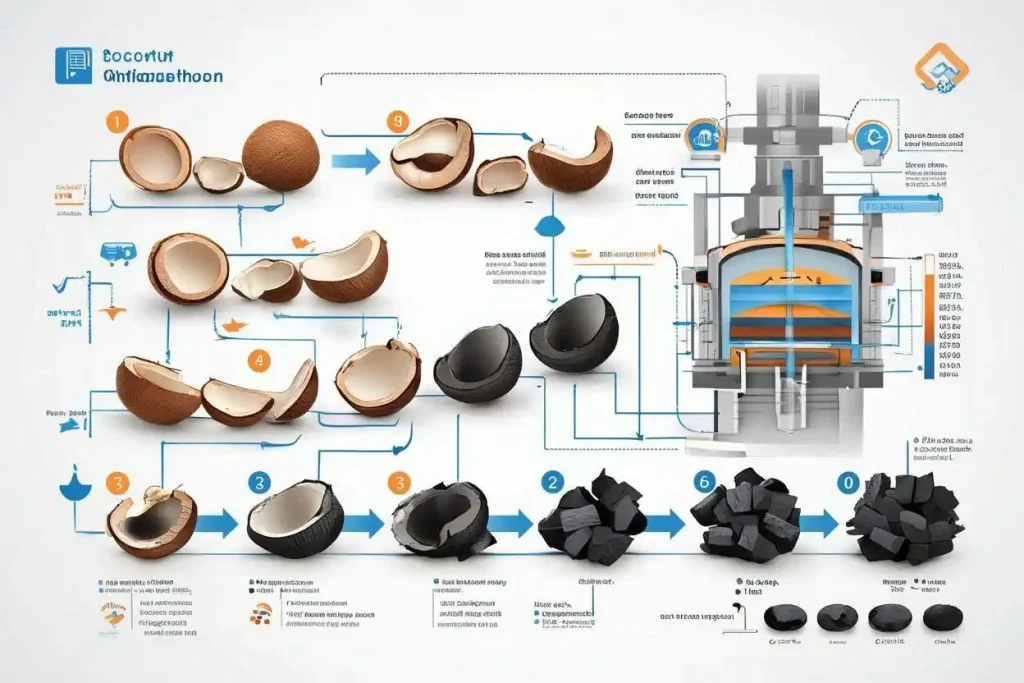
The carbonization process starts with selecting good-quality coconut shells. Producers ensure shells remain dry and free from contamination. Additionally, workers standardize shell sizes through breaking processes to guarantee even burning.
Then, workers sun-dry the broken shells until moisture content reaches maximum 15 percent. Excessive water content disrupts carbonization efficiency and lowers charcoal quality. Consequently, the drying stage forms an important foundation for production success.
Furthermore, workers conduct re-sorting to separate materials that don’t meet standards. The best quality shells produce charcoal with high carbon content. Indeed, meticulous preparation determines subsequent process success.
Understanding the Carbonization Process in Kilns
Coconut shell carbonization process occurs in kilns with controlled temperatures. Initially, operators start temperature from 150-200 degrees Celsius to remove remaining moisture. Subsequently, they gradually increase temperature until reaching 400-600 degrees Celsius.
At this stage, shells undergo thermal decomposition without oxygen or with limited oxygen. This pyrolysis breaks down organic compounds into solid carbon and volatile gases. Notably, how coconut charcoal briquettes are made begins from this carbonization before briquetting.
Carbonization duration varies between 6-12 hours depending on kiln capacity. Meanwhile, operators monitor temperature consistently to avoid excessive or incomplete burning. As a result, proper control produces charcoal with carbon content reaching 75-85 percent.
Post Carbonization Cooling and Processing Steps
After carbonization completes, operators cool charcoal gradually in a closed environment. Otherwise, sudden cooling causes cracks and reduces product quality. The cooling process requires 12-24 hours to ensure charcoal stability.
Then, workers sort cooled charcoal based on size and quality. High-quality charcoal displays deep black color and hard texture. Moreover, good charcoal doesn’t crumble when pressed.
Further processing includes grinding, binder mixing, and briquette formation if required. Consequently, this stage transforms charcoal fragments into products with higher value. For comprehensive guidance on charcoal industry, alladsmedia.com provides beneficial references.
Quality Standards in Shell Carbonization
Technicians conduct quality testing on every production batch to ensure consistency. Specifically, they test parameters including carbon content, ash content, moisture content, and calorific value. International standards require ash content at 5 percent for premium category.
Furthermore, laboratory testing measures calorific value which should reach minimum 7000 kcal/kg. Similarly, producers maintain moisture content below 8 percent for storage durability. Thus, products meet domestic and export expectations.
Documentation forms an important part of product certification. Indeed, certificates like ISO and SGS provide high credibility for buyers. Therefore, investment in quality control generates positive reputation and loyalty.
Environmental Impact of Carbonization Process
Modern coconut shell carbonization process uses technology that minimizes harmful emissions. Specifically, recovery systems capture volatile gases and convert them into energy. As a result, this approach increases efficiency and reduces carbon footprint.
Then, producers utilize combustion ash as organic fertilizer or raw material. This zero waste principle creates economic value while maintaining sustainability. Moreover, environmentally friendly technology opens access to premium markets.
Conclusion
Coconut shell carbonization process represents key technology in transforming coconut shell waste into high-quality charcoal. This process involves raw material preparation, controlled carbonization, gradual cooling, and strict quality control. Each stage requires deep technical understanding to produce consistent specifications. Implementing modern technology and environmental principles increases efficiency while opening wider market opportunities. Investment in proper carbonization processes establishes sustainable, profitable charcoal business demonstrating environmental responsibility.