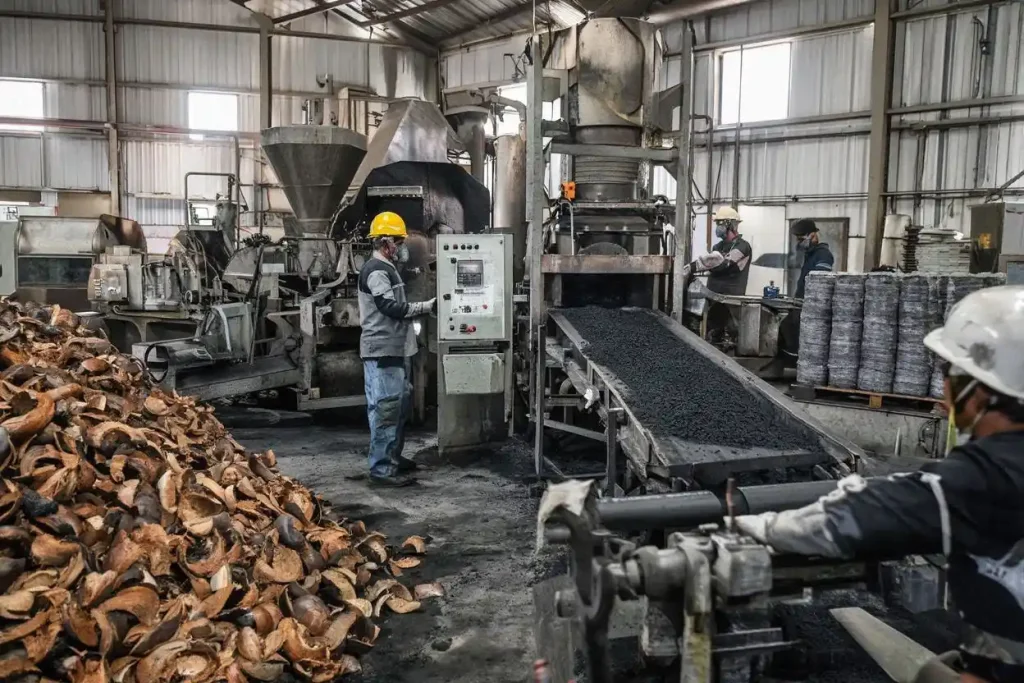
The coconut charcoal briquette industry continues to grow rapidly in global markets. How coconut charcoal briquettes are made becomes an important question for business owners wanting to understand the production process thoroughly. This understanding helps produce high-quality products with international standards.
Many entrepreneurs enter this business due to its promising profit potential. Additionally, the production process is relatively simple but requires strict quality control.
Preparing Coconut Shell Raw Materials
How coconut charcoal briquettes are made begins with selecting quality raw materials. First, producers collect coconut shells from coconut processing industries or traditional markets. Then, workers clean these shells from fibers and attached dirt.
Subsequently, operators conduct a drying process to reduce moisture content in the shells. Usually, natural drying requires 2-3 days under direct sunlight. As a result, shells become easier to burn and produce optimal quality charcoal.
After drying, workers sort shells based on size and condition. Thus, the carbonization process can run more efficiently and produce consistent output.
Carbonization Process of Making Briquettes
The next stage involves carbonization or controlled burning. Specifically, workers place shells into carbonization kilns at temperatures of 400-600 degrees Celsius. This process lasts 6-8 hours depending on kiln capacity.
During carbonization, operators limit oxygen to prevent complete combustion. Consequently, shells transform into charcoal with high carbon content reaching 75-85 percent. Then, workers cool the charcoal gradually to avoid spontaneous combustion.
Several common carbonization methods include:
- Simple drum kilns for small scale
- Fire-resistant brick kilns for medium production
- Modern retort kilns for large industrial scale
Grinding and Mixing Process
After carbonization, workers continue making coconut charcoal briquettes through grinding. First, operators crush cooled charcoal using crusher machines or manual pounders. As a result, charcoal becomes fine powder with mesh size 60-80 for optimal quality.
Subsequently, workers mix charcoal powder with natural binders such as tapioca or corn starch. Generally, the mixture contains 85-90 percent charcoal and 10-15 percent binder. Then, operators add water sufficiently to achieve the right dough consistency.
Workers perform mixing using industrial mixers for 15-20 minutes. Thus, binder distribution becomes even throughout the charcoal mixture.
Molding and Drying Stage
Another important stage involves molding the charcoal dough. Operators insert dough into hydraulic press machines or extruders to form briquettes. Usually, producers create shapes including cubes, cylinders, hexagonals, or according to market demand.
Machines apply pressure ranging from 150-250 bar to produce dense and hard briquettes. Moreover, high density ensures longer burning duration and optimal energy efficiency.
After molding, workers dry briquettes to reduce moisture content to below 8 percent. Operators use sunlight or drying ovens at temperatures of 60-80 degrees Celsius.
Quality Control and Packaging
Understanding production also includes strict quality control stages. First, technicians test dried briquettes for moisture, ash content, and calorific value. Then, workers separate products that don’t meet standards for reprocessing.
Choosing a coconut charcoal briquette supplier that implements strict quality control guarantees product consistency. In fact, professional suppliers conduct laboratory testing for every production batch.
After passing quality control, workers package briquettes in sacks or boxes according to export specifications. For more complete information about quality standards, you can visit jacoid.com which provides comprehensive guides for the industry.
Conclusion
Understanding how coconut charcoal briquettes are made provides deep insights into the production process that transforms coconut shell waste into high-value products. Every stage from raw material preparation, carbonization, grinding, molding, to packaging requires detailed attention to produce premium quality briquettes. This process creates profitable business opportunities while supporting environmental sustainability through organic waste utilization. By mastering proper production techniques and implementing consistent quality control, business owners can produce briquettes that meet global market standards.